

Table of Contents
Opening: The Mistake
Layer 1: The Visible Energy Flow
Layer 2: The Food-Chain Flow
Layer 3: The Industrial Flow
Layer 4: High-Tech Gases
Layer 5: Digital Infrastructure
Conclusion: The Compression Point
Opening: The Mistake
We call the Strait of Hormuz an oil chokepoint because oil is the easiest thing to see.
When international crises gather around the waters between Iran and Oman, the global reaction follows a well-rehearsed script. Satellite trackers lock onto supertankers, commodities desks reprice Brent crude in real time, and marine insurers recalibrate war-risk premiums for the Persian Gulf. The story is immediately framed as a clash over energy transit: barrels per day, transit permits, and naval escorts.
This framing is not wrong, but it is surface-level. We need to look beyond the tankers and examine the layers beneath to understand the true fragility of the modern economy.
👁️ BLINDSPOT Shift
By defining the Strait of Hormuz strictly through the lens of crude oil, we fall for a geographic illusion. We mistake the most visible commodity for the total volume of risk.
Beneath the surface layer of petroleum flows sits a dense network of global dependencies – ranging from agricultural inputs and industrial metals to strategic high-tech gases and the subsea digital nervous system connecting East to West.
To grasp how the deeper layers operate, we must first recognize the physical scale of what traverses the Strait of Hormuz between Iran and Oman: a narrow maritime corridor whose navigable shipping lanes are only two nautical miles wide in each direction.
Layer 1: The Visible Energy Flow
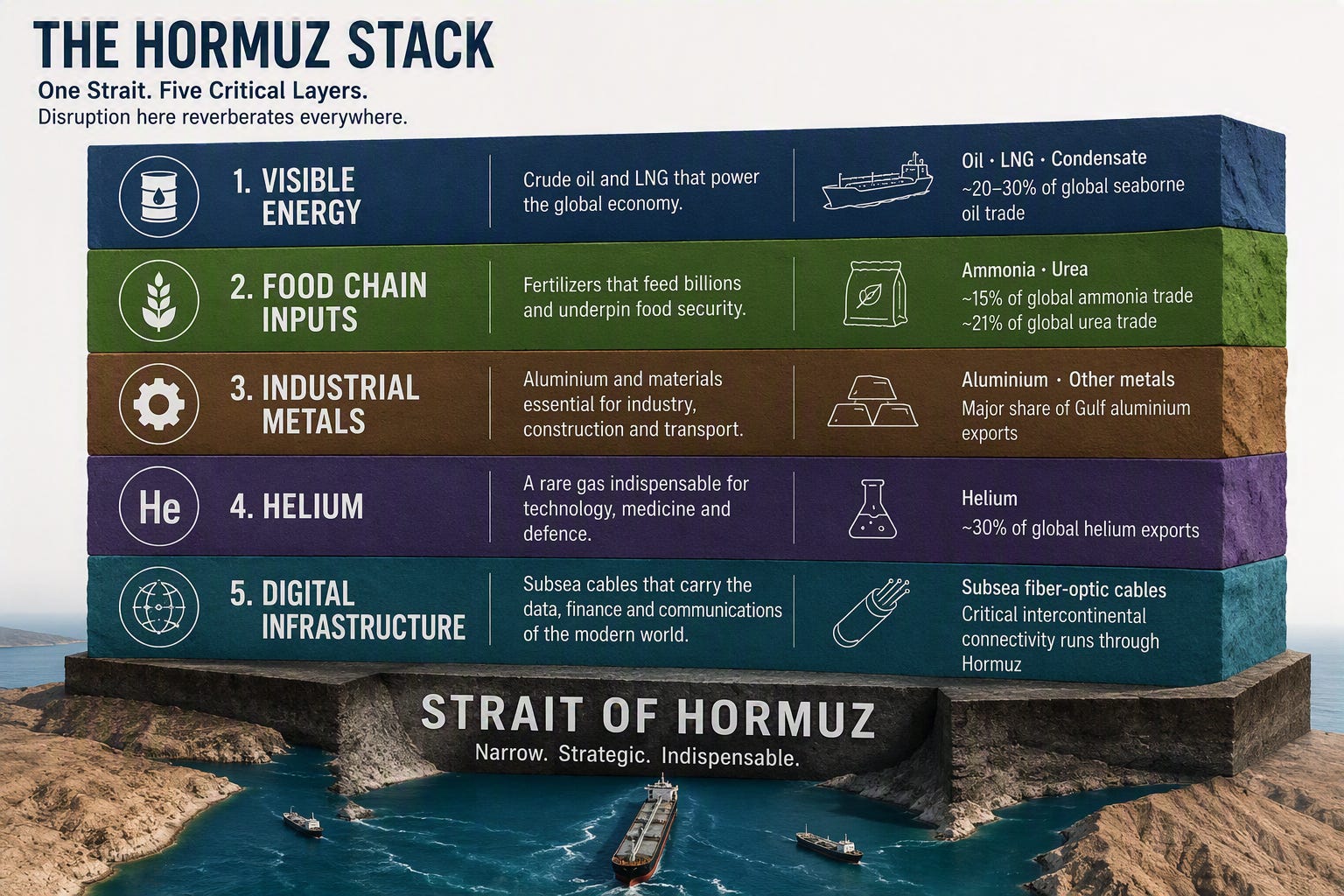
The first layer of this compression is energy.
Data from the U.S. Energy Information Administration (EIA) show that an average of roughly 20 million barrels of crude oil and refined petroleum products transited the Strait daily in 2024. That volume accounted for nearly 20% of global petroleum liquids consumption and roughly a quarter of all seaborne-traded oil worldwide. It is the primary exit route for crude oil and condensate originating from Saudi Arabia, Iraq, Kuwait, Iran, and the United Arab Emirates (UAE).
Beyond fuels, these hydrocarbon flows underpin vast petrochemical processing networks, producing plastics, synthetic fibers, and industrial feedstocks embedded in modern manufacturing.
Parallel to the tanker traffic runs one of the world’s most critical seaborne gas corridors: Liquefied Natural Gas (LNG). International Energy Agency (IEA) figures highlight that 93% of Qatar’s total LNG exports and 96% of the UAE’s LNG exports pass through the Strait of Hormuz. Together, these flows represent nearly a fifth of global LNG trade, with over four-fifths of those shipments bound for Asian economies, including China, India, Japan, and South Korea.
In the public imagination and most market analyses, this is where the story ends. The assumption remains that if energy flows continue – or if strategic reserves can buffer a short-term disruption – the global economy survives unscathed.
That assumption is a dangerous blind spot. Energy is simply the top layer of the stack – the most visible cargo, but far from the only one that keeps the modern world running.
Layer 2: The Food-Chain Flow
If an energy shock is an immediate cardiac event for financial markets, a fertilizer shock is a slow-moving, systemic organ failure.
When energy analysts debate the consequences of a Hormuz closure, the secondary impact on global agriculture is rarely part of the headline calculation. Yet the Persian Gulf is not merely an energy province. It is also one of the world’s largest factories for synthetic soil fertility.
Nitrogen-based fertilizers – specifically urea and ammonia – are synthesized through energy-intensive processes that require massive volumes of natural gas as both fuel and chemical feedstock. Because the Gulf states possess low-cost gas reserves, the region has transformed into a dominant global hub for fertilizer manufacturing and export.
Data from The Fertilizer Institute indicate that a severe disruption in the Strait of Hormuz directly threatens global supplies of ammonia, urea, sulfur, phosphates, and natural gas. Nearly 50% of total global urea exports originate from countries situated west of the Strait of Hormuz, relying on the Strait to reach international markets. Furthermore, nearly half of the world’s sulfur exports – a key component in phosphate fertilizer production – originate from this same geography.
Rystad Energy’s 2025 trade mapping suggests that a prolonged closure of the Strait of Hormuz would place significant pressure on global fertilizer markets. According to their analysis, the sale of 15% of global ammonia and 21% of global urea is tied to exporters potentially affected by such a disruption.
The true risk lies in the temporal mismatch. The first political reaction to a crisis in the Strait of Hormuz centers on oil spikes at the pump. But the second-order effect does not register on Bloomberg terminals overnight. It travels silently through distribution channels over months and across planting cycles – manifesting in inflated planting costs, reduced yields, compromised crop cycles, and eventually, structural food price inflation.
An oil shock changes how much it costs to drive to the supermarket; a fertilizer shock changes how much it costs to stock the shelves.
Layer 3: The Industrial Flow
Beyond fuels and agricultural inputs, the third layer reveals a counterintuitive vulnerability: the Strait of Hormuz is not only a gateway for outbound raw materials, but a bi-directional bottleneck for global manufacturing.
Consider the metallurgy of modern infrastructure. The Middle East accounts for approximately 9% of global primary aluminum production. Mega-scale smelters across the UAE, Bahrain, and Qatar produce high-purity aluminum that feeds global automotive, aerospace, packaging, and construction sectors. However, transforming energy into metal requires a continuous inward supply of mineral inputs: bauxite and refined alumina.
This creates a high-stakes import-export loop dependent on the Strait of Hormuz. Gulf smelters rely on imported bauxite and alumina shipped from mines in West Africa and Australia. If bulk carriers cannot enter the maritime corridor, smelters face severe operational stress in an industry where prolonged shutdowns can cause costly damage to production infrastructure.
The Strait of Hormuz is a critical artery operating in both directions. A disruption hits the metals market simultaneously: it strangles the inward flow of raw minerals and chokes off the outward flow of finished industrial alloys.
The Strait does not simply dictate the cost of shipping a final product. It sits directly inside the assembly line, governing the price of raw aluminum before a vehicle frame, aircraft fuselage, or high-voltage power line can even be cast.
Layer 4: High-Tech Gases
Most people encounter helium as a novelty for party balloons. In reality, one of its most critical applications sits quietly in hospital basements around the world. Many conventional MRI systems depend on liquid helium to keep their superconducting magnets operational. Without it, those systems cease to function.
If oil powers the modern economy, helium cools its most sophisticated machines. Beyond medical imaging, ultra-pure helium is an irreplaceable carrier and cooling gas in semiconductor fabrication facilities, aerospace production lines, and advanced scientific laboratories.
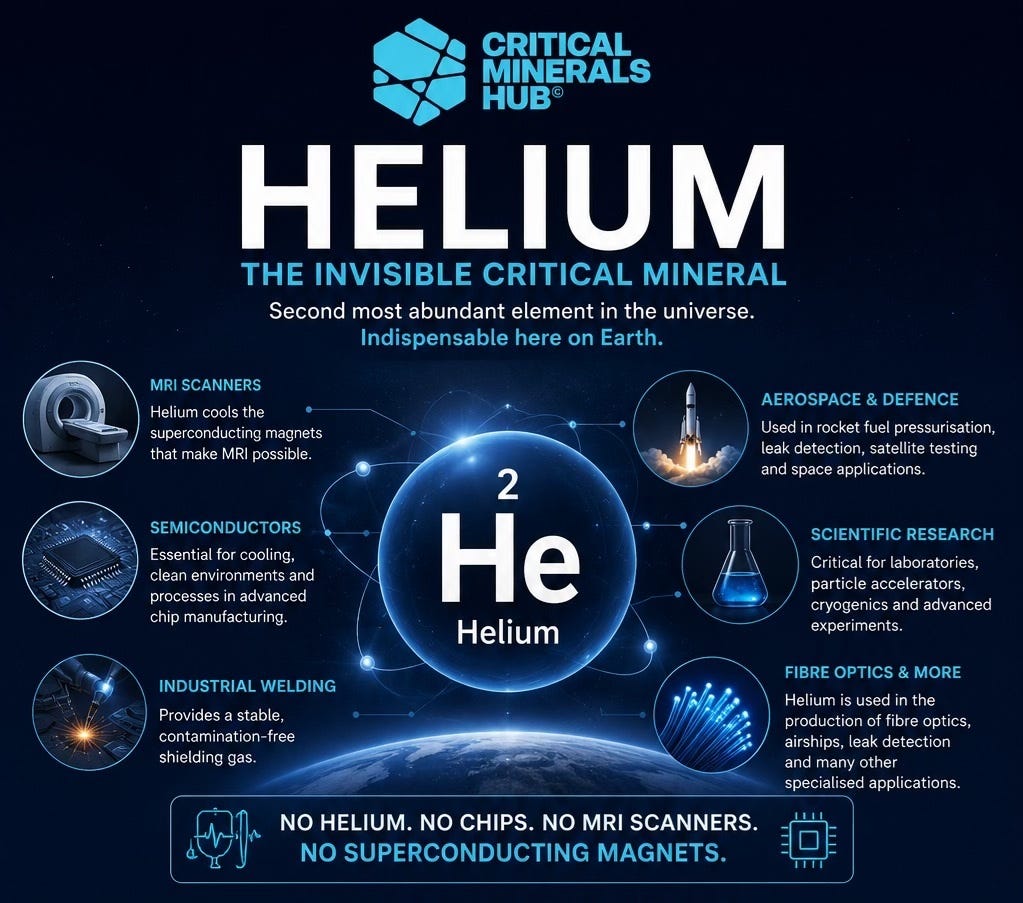
The structural trap of helium lies in its production geography. It is not commercially produced on demand; it must be extracted during natural gas processing. Because Qatar operates major LNG processing facilities at Ras Laffan, it accounts for roughly one-third of global helium supply.
If LNG transport through the Strait of Hormuz stops or slows, helium output is throttled at the source. Unlike crude oil, which can be stored in underground salt caverns or tank farms for months, liquid helium cannot be easily hoarded. Its tiny molecular size allows it to seep through containment vessels, resulting in steady boil-off losses over time.
Layer 5: Digital Infrastructure
The final layer of the stack is completely invisible to passing ships. It moves neither in liquid nor solid form, but as pulses of light traveling along the seabed.
While global media monitors tanker tracking systems in the Strait of Hormuz, network engineers monitor subsea fiber-optic cables. The geographic compression point that squeezes physical energy flows also forces a dense concentration of regional and international digital traffic through the exact same corridor.
Analyses of regional internet routing, such as those by FastNetMon, demonstrate that a significant portion of international data connectivity in the Persian Gulf depends on subsea cable systems laid along the floor of the Strait of Hormuz. These fiber lines link major regional landing stations – such as those in Oman, the UAE, and Qatar – to global terrestrial and maritime backbones connecting Europe, Africa, and Asia.
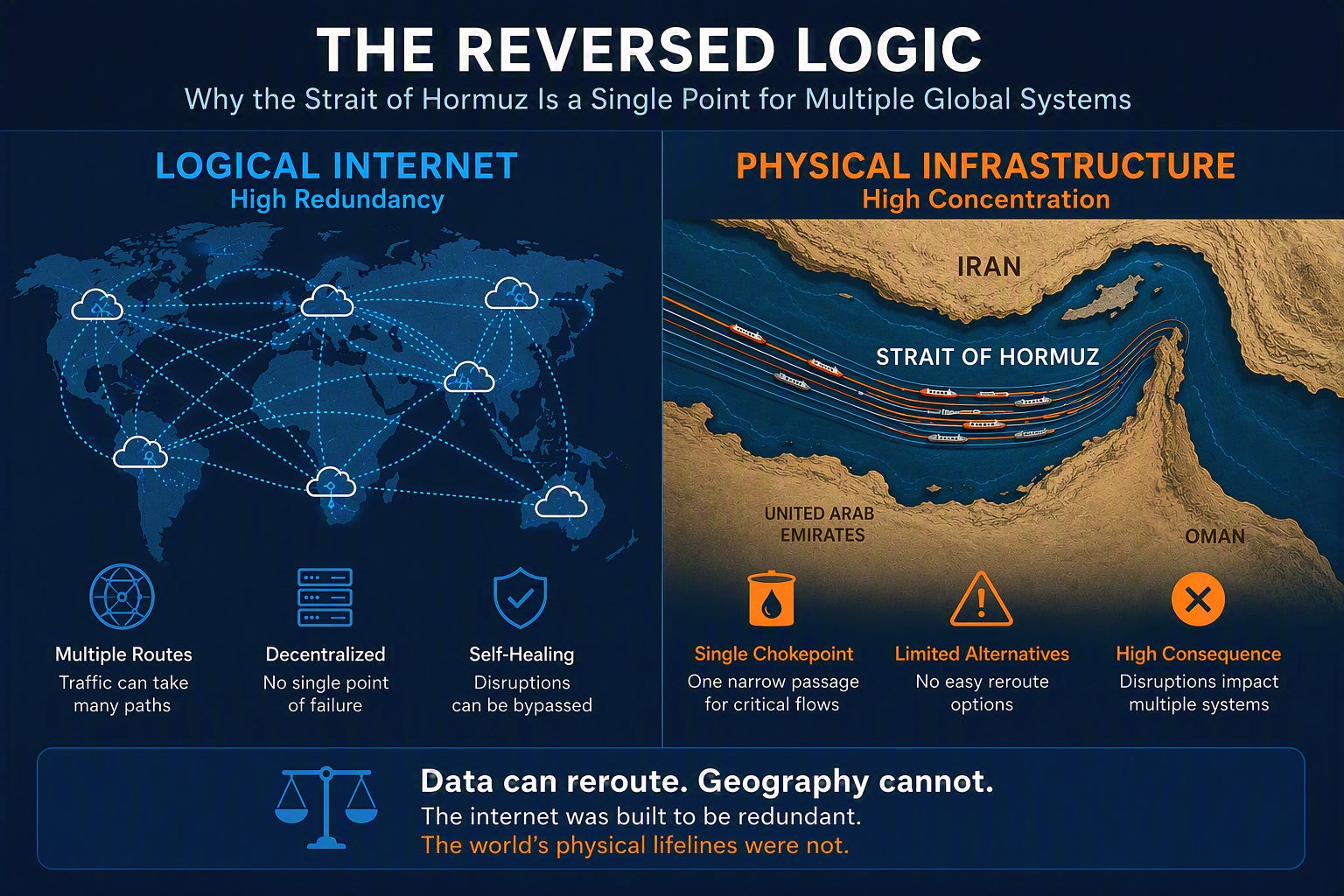
This highlights a crucial distinction that risk models often ignore: the difference between logical redundancy and physical vulnerability.
Software protocols allow internet data to be rerouted dynamically when a line breaks. However, that logical resilience relies on physical hardware that remains concentrated. In contested waters like the Strait of Hormuz, subsea cables are exposed to anchor drags, commercial fishing hazards, and deliberate damage. Repairing a severed cable in a militarized zone presents logistical hurdles, requiring specialized vessels that cannot operate safely without geopolitical guarantees.
A disruption to this digital layer does not simply mean slower consumer internet. It threatens financial transactions, e-commerce, cloud services, online communications, market-data flows, and the digital coordination systems on which ports and logistics networks depend.
The physical supply chain and the digital supply chain do not exist in separate universes. They rest on the exact same seabed.
Conclusion: The Compression Point
Modern trade is optimized for efficiency. In the pursuit of this efficiency and economies of scale, we have built a global architecture that relies on geographic compression.
We tend to evaluate maritime risks in isolation: commodities traders look at oil barrels, agronomists look at urea shipments, tech executives track semiconductor inputs, and network engineers monitor cable maps. But geopolitics does not respect corporate silos. When crisis strikes a physical bottleneck like the Strait of Hormuz, all of these dependencies are squeezed simultaneously.
The lesson of Hormuz is not about oil. It is about concentration. The modern world has layered energy systems, food and industrial supply chains, advanced technologies, and digital infrastructure onto the same narrow geography. The more efficiently we build, the more fragile the compression becomes.
Further Reading
Transit or Innocent?
Interested in the legal and strategic dimensions of the Strait of Hormuz? This essay explores the legal framework governing navigation through the Strait, including why transit passage and innocent passage matter in regional security calculations.
Sources, References, and Methodology
Sources, references, and methodology are provided separately to keep the estimated reading time accurate and the essay easier to read. You can find them HERE.
The deeper vulnerability may not be concentration alone, but synchronization failure.
Hormuz compresses systems with radically different buffering and recovery clocks into the same geography. Oil can be stockpiled and partly rerouted; LNG has far less bypass flexibility; fertilizer disruption propagates through planting cycles; aluminum smelters face restart physics; and digital traffic may reroute logically while the damaged physical layer still requires specialized repair.
That means the strategic variable is not simply what passes through Hormuz, but how long each affected system can preserve its function after disruption — and how failure in one layer propagates into the others.
In that sense, Hormuz is more than a chokepoint. It is a multi-system synchronization point. And a synchronization point does not necessarily have to be fully closed to produce systemic effects; persistent partial disruption may be enough to desynchronize inventories, production cycles, logistics, insurance, and recovery capacity.
Excellent analysis, which goes well beyond what the networks repeatedly focus on: the familiar headline that roughly 20% of the world’s oil passes through the Strait. Well written, thoughtful, and informative. Thank you for sharing.
What surprises me most is that, despite all the other multilayered risks and dependencies you describe, the stock market seems remarkably poor at incorporating them into its risk assessment. Markets are supposed to discount the future, yet they often appear to price what is easily measurable while underweighting interconnected geopolitical, logistical, and second- and third-order risks whose consequences are much harder to quantify.
Perhaps the real vulnerability is not that these risks are unknown, but that they remain inadequately priced until one of them becomes reality. Then, suddenly, this hits the fan. Markets discover the price of what they failed to price. Risk ignored eventually becomes cost realized, and that tends to stink up the place.